DevOps Learning and Research
Certifications
Vmware application modernization
Vmware tanzu kubernetes grid
03 Tanzu Kubernetes Clusters
3.7 - Managing Cluster Lifecycles
Learner Objectives
Describe the VMs that make up a Tanzu Kubernetes cluster
Describe the pods that run on a Tanzu Kubernetes Cluster
Describe the Tanzu Kubernetes Grid core add-ons that are installed on a cluster
Tanzu Kubernetes Cluster VMs
Depending on the plan used, the following VMs will be created:
Control plan VMs: <cluster name>-control-pane-......
Worker node VMs: <cluster name>-md-0-........
There will always be one or more of each.
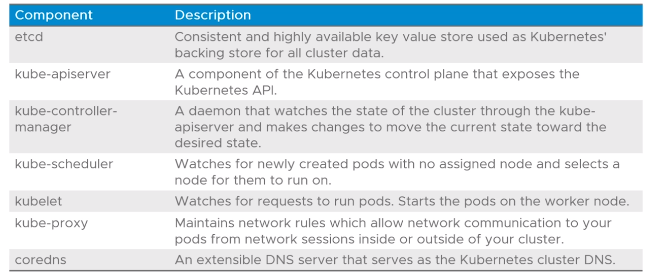
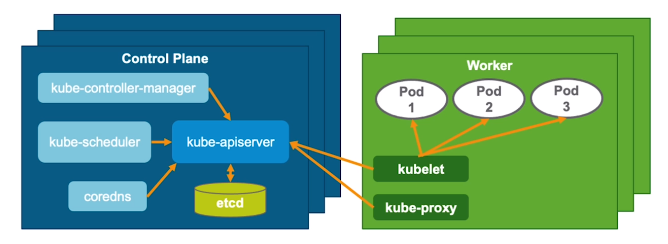
Upstream Kubernetes Components
A number of standard Kubernetes components will be included upon deployment.
Kubernetes API High-Availability
The component kube-vip provides HA load-balancing for the Kubernetes control-plane
By default, if included, it runs on every control plane.
In classic HA fashion, one of the nodes will be elected the "leader" and advertises the virtual IP address using Address Resolution protocol
If the node fails or becomes unhealthy, a leader election happens - a new leader will be elected from the available controlplane nodes and the winner will advertise the virtual IP address via ARP.
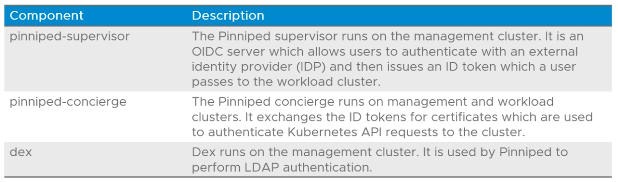
Authentication Core Addons
By default, TKG will implement Pinniped for cluster authentication, it comes with the following components:
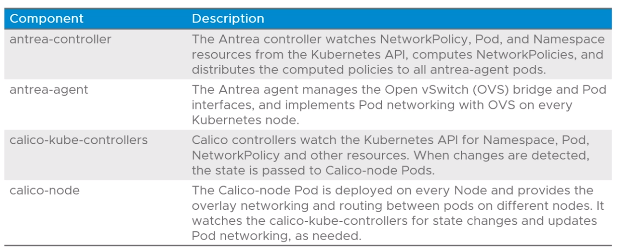
Networking Core Addons
Tanzu Kubernetes Grid supports Antrea (default) or Calico as the container network interface (CNI) for in-cluster networking.
Each come with their own components:
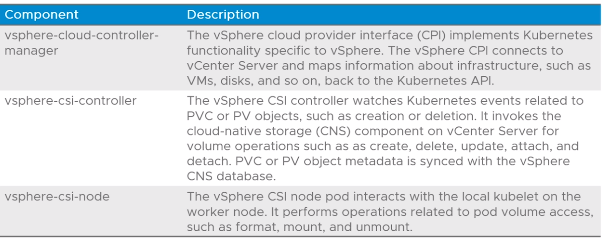
vSphere Core Addons
For each IaaS provider - additional components will also be deployed. For vSphere, the components are outlined as follows.
Metrics Core Addons
Tanzu Kubernetes Grid deploys a metrics server to management and workload clusters by default:
metrics-server: Collects resource metrics from kubelets and exposes them in the Kubernetes API for use by Horizontal and Vertical Pod autoscalers