Skip to content

3.7 - Managing Cluster Lifecycles

Learner Objectives

  • Describe the VMs that make up a Tanzu Kubernetes cluster
  • Describe the pods that run on a Tanzu Kubernetes Cluster
  • Describe the Tanzu Kubernetes Grid core add-ons that are installed on a cluster

Tanzu Kubernetes Cluster VMs

  • Depending on the plan used, the following VMs will be created:
  • Control plan VMs: <cluster name>-control-pane-......
  • Worker node VMs: <cluster name>-md-0-........
  • There will always be one or more of each.

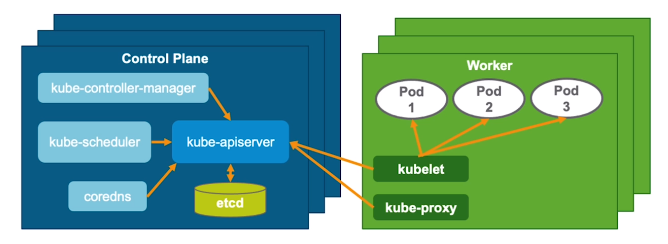
Upstream Kubernetes Components

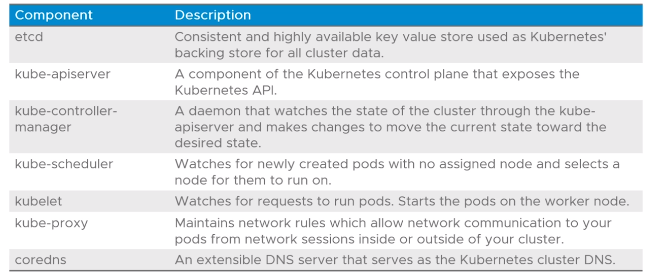
  • A number of standard Kubernetes components will be included upon deployment.

Untitled

  • Architecturally:

Untitled

Kubernetes API High-Availability

  • The component kube-vip provides HA load-balancing for the Kubernetes control-plane
  • By default, if included, it runs on every control plane.
  • In classic HA fashion, one of the nodes will be elected the "leader" and advertises the virtual IP address using Address Resolution protocol
  • If the node fails or becomes unhealthy, a leader election happens - a new leader will be elected from the available controlplane nodes and the winner will advertise the virtual IP address via ARP.
Authentication Core Addons

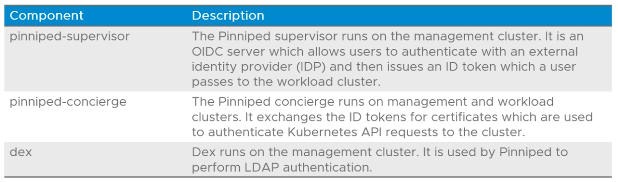
  • By default, TKG will implement Pinniped for cluster authentication, it comes with the following components:

Untitled

Networking Core Addons

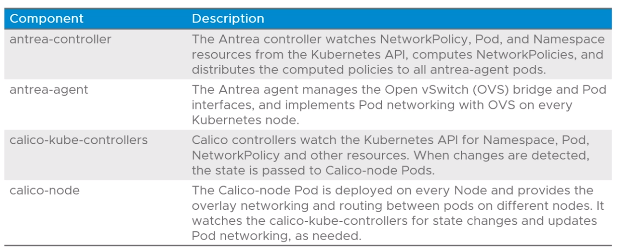
  • Tanzu Kubernetes Grid supports Antrea (default) or Calico as the container network interface (CNI) for in-cluster networking.
  • Each come with their own components:

Untitled

vSphere Core Addons

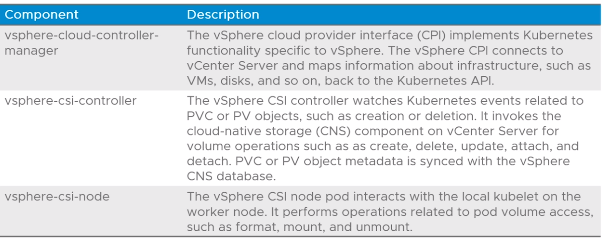
  • For each IaaS provider - additional components will also be deployed. For vSphere, the components are outlined as follows.

Untitled

Metrics Core Addons

  • Tanzu Kubernetes Grid deploys a metrics server to management and workload clusters by default:
  • metrics-server: Collects resource metrics from kubelets and exposes them in the Kubernetes API for use by Horizontal and Vertical Pod autoscalers